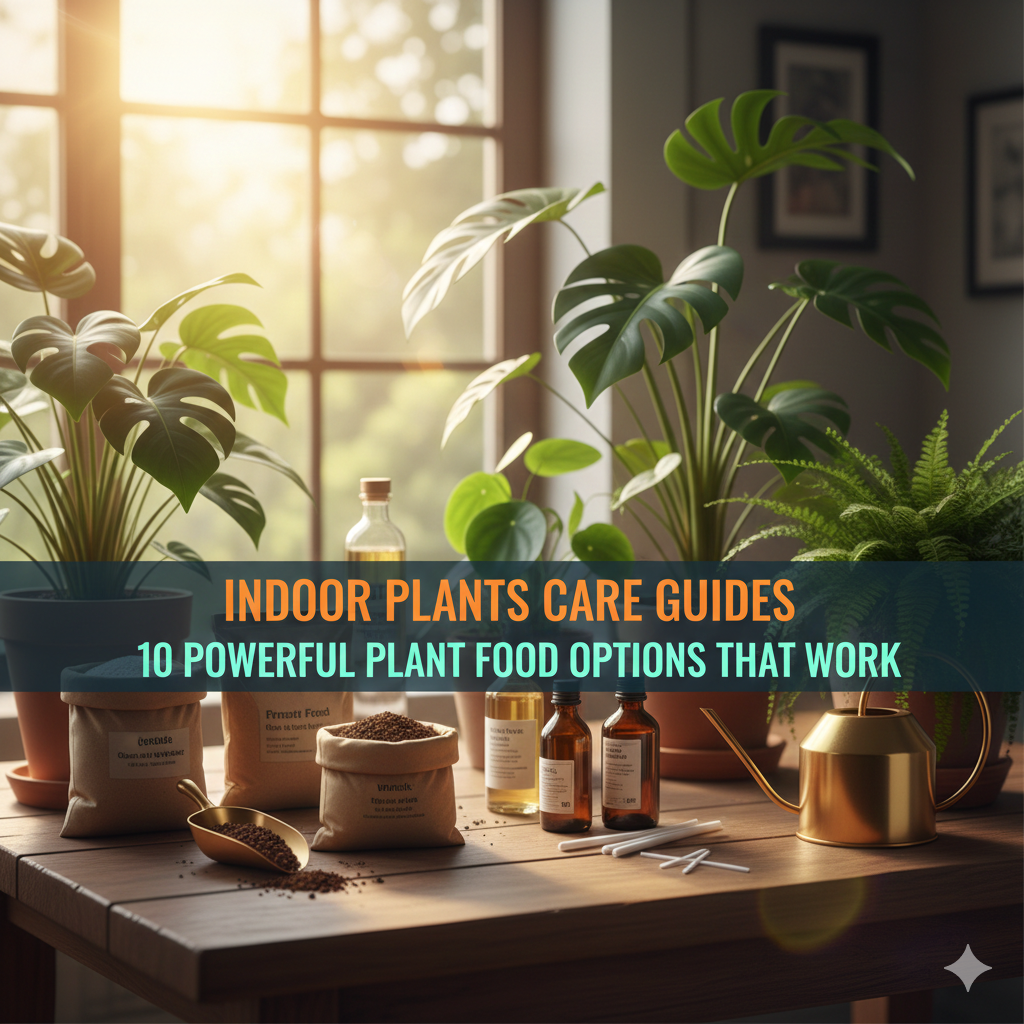
Indoor Plants Care Guides: 10 Best Powerful Plant Food That Work
Something is being said to you by your house plants. Your plant is hungry when the leaves become yellow, growth is slowed down, or the stems appear weak. Indoor plants just like humans require nutrients to maintain their own health as well as ensure that they grow into strong and beautiful beings.
The good news? You do not need a complex degree in botany to be able to keep your plants healthy. All one requires is the correct plant food and a simple schedule.
This list of 10 effective plant foods shows you how to work with them. As a beginner or an expert in the plant parenting industry, you will find something that suits your needs and values.
Let’s dig in.
Why Indoor Plants Need Extra Feeding
External vegetation extracts the nutrients of the soil, rain, and natural decay. Indoor plants can’t do that. They find themselves in pots of a predetermined quantity of soil. In the long run, that soil is deficient in nutrients — and your plant is crippled.
Feeding plants refills the amount of lost nutrients and provides the plants with what they need to photosynthesize, generate new leaves, and resist pests.
For more in-depth care tips, plant guides, and growing advice, visit Indoor Plants Guide — a helpful resource for every plant parent.
The Three Major Nutrients Every Plant Should Have
There are three key nutrients that are found in most plant foods. They are shown in fertilizer labels in the form of numbers, such as 10-10-10 or 5-10-5. These numbers refer to:
| Nutrient | Symbol | What It Does |
|---|---|---|
| Nitrogen | N | Increases growth of the leaves and stems |
| Phosphorus | P | Strengthens roots and aids in blooming |
| Potassium | K | Enhances the general health and resistance to diseases of the plants |
In addition to these three, plants also require other types of secondary nutrients such as calcium, magnesium, and sulfur — as well as other trace minerals such as iron and zinc.
How to Read a Label on a Packet of Fertilizer
You should always take a look at the NPK ratio before purchasing any plant food by inverting it. A proportion of 20-20-20 depicts the same quantity of all three nutrients. A ratio such as 5-10-10 implies less nitrogen and more phosphorus and potassium — better for flowering plants.
This will allow you to select the correct food for the correct plant at the correct time.
The 10 Powerful Plant Foods for Indoors
1. Liquid Fertilizers — Fast-Acting Classic
Liquid fertilizers are added to water and you can use them in the process of your normal watering schedule. They are fast absorbing and effective — showing results in as short a time as a few days.
They are good for plants that require an immediate boost or when the plant is growing actively such as in spring and summer.
Best for: Pothos, philodendrons, peace lilies, ferns
How to use: Add the liquid to water as outlined on the label. Apply every two to four weeks during growing season. Reduce or stop during winter.
Popular pick: Miracle-Gro Indoor Plant Food Liquid
Advantages: Rapid action, simple dosage adjustment Disadvantages: Required to be re-applied frequently, can lead to over-fertilization
2. Slow-Release Granular Fertilizer — Set It and Forget It
In case you are the kind who fails to fertilize on a regular basis, then granular fertilizers are your allies. You pour them on the soil or into it and they gradually release nutrients over the course of weeks or months.
Best for: Large container plants, snake plants, ZZ plants
How to use: Sprinkle the recommended amount on the soil surface. Water as usual. Most formulas last 2–4 months.
Advantages: Long-lasting, low maintenance Disadvantages: Slower results, difficult to adjust after application
3. Worm Castings — Nature’s Gold for Plants
Worm castings are exactly what they sound like — worm poop. And plants love it. It is a 100% organic product that is loaded with nutrients, beneficial bacteria, as well as enzymes that enhance the soil structure and health of plants.
Even when you put on too much, it will not burn your plants. That is why it is one of the safest options available.
Best for: All indoor plants, and particularly herbs and edibles
How to use: Add to potting soil or use as a top dressing. You can also prepare worm casting tea by immersing the castings in water overnight, then the water can be used to feed your plants.
Advantages: Organic, safe, and enhances the health of the soil Disadvantages: Sluggish performance, may be difficult to locate locally
4. Fish Emulsion — Powerful Smell, Powerful Performance
Processed fish byproducts are used to make fish emulsion. It contains high nitrogen levels, making it an awesome choice for enhancing the growth of leafy greens. The only downside? It smells. A lot.
Use it in open air or well-ventilated places preferably.
Best for: Tropical foliage plants, ferns, monstera
How to use: Dilute in water (1 tablespoon per gallon of water) and apply every two weeks throughout the growing season.
Advantages: Very effective, organic, cheap Disadvantages: Strong smell, cannot be used indoors without ventilation
5. Compost Tea — DIY Power Boost
Compost tea is prepared by placing compost in water and leaving it to brew for 24–48 hours. The water takes in nutrients and good microorganisms to form a liquid fertilizer that can be used to water your plants.
It is a favorite among people who are environmentally conscious and in love with plants, since it is completely natural and free if you already compost at home.
Best for: Herbs, vegetables, tropical plants
How to use: Fill a bucket with water, put compost in a mesh bag, and leave it to stand for 1–2 days. Remove the compost and apply the tea immediately.
Advantages: Free, environmentally friendly, enhances soil biology Disadvantages: Time-consuming to prepare, short shelf life
6. Balanced Granular Fertilizer (10-10-10) — The All-Rounder
To play it safe, a good all-purpose fertilizer to use with your plant would be a balanced 10-10-10 granular fertilizer. It contains an equal quantity of the three essential nutrients — not too much or too little.
It is a general-purpose product for most indoor plants and is commonly found in garden centers.
Best for: General houseplants, palms, rubber plants
How to use: Apply as directed. Usually done every 4–6 weeks in spring and summer.
Advantages: Multifunctional, readily available, cheap Disadvantages: No specialization for certain types of plants
7. Kelp Meal and Seaweed Extract — Plant Superfood from the Ocean
Fertilizers made of seaweed contain high levels of micronutrients, growth hormones, and amino acids. They help plants handle stress factors such as heat, drought, or repotting, and aid in the growth of stronger root systems.
They will not cause any extreme increase in plant size on their own, but they enhance the general resilience and wellbeing.
Best for: All plants, and particularly when transplanting or stressed
How to use: Add kelp meal to the soil during potting, or use liquid seaweed extract diluted in water every 2–4 weeks.
Advantages: Enhances tolerance to stress, increases the level of micronutrients Disadvantages: Low in major nutrients, works best as a supplement
According to the Royal Horticultural Society, seaweed-based fertilizers are among the most beneficial organic options for improving plant resilience and soil health.
8. Epsom Salt — The Magnesium Miracle
Epsom salt is magnesium sulfate, and plants use magnesium to produce chlorophyll — the green pigment that makes photosynthesis possible. At low magnesium levels, the leaves develop a yellow color between the veins, a phenomenon known as interveinal chlorosis.
Epsom salt is inexpensive, readily available, and quick-acting.
Best for: Roses, tomatoes, peppers, plants with yellowing leaves
How to use: Dissolve 1 tablespoon of Epsom salt in 1 gallon of water. Use as a foliar spray or as a soil drench once a month.
Advantages: Inexpensive, treats magnesium deficiency, widely available Disadvantages: Not a complete fertilizer, only covers magnesium and sulfur
9. Organic Granular Fertilizer (Bone Meal + Blood Meal) — The Specialist Combo
Bone meal contains a lot of phosphorus that is used in the growth of roots and flowering. Blood meal contains a lot of nitrogen, which promotes the growth of leaves. The combination of the two is a formidable organic duo.
They are sold either together or individually in the majority of garden stores.
Best for: Flowering plants, fruiting plants, newly repotted plants
How to use: Pour into the soil at the time of planting or apply as a top dressing. Follow the instructions on the package carefully — a little will do.
Advantages: Long-lasting, targeted, and organic nutrition Disadvantages: Smells strongly, not applicable to all plants, can attract pests
10. Succulent and Cactus Fertilizer — Specially Made for Tough Plants
Succulents and cacti do not have the same needs as tropical foliage plants. They require less nitrogen and more phosphorus and potassium. Applying a normal houseplant fertilizer to them may result in weak and leggy growth.
The fertilizers designed specifically for succulents are formulated with the right balance.
Best for: Succulents, cacti, aloe vera, jade plants
How to use: Use in spring and summer only. Once a month is a reasonable frequency. Stop feeding in fall and winter when growth is retarded.
Advantages: Specially balanced for drought-tolerant plants Disadvantages: Applicable only to a narrow range of plants
Quick Comparison: All 10 Plant Foods at a Glance
| Plant Food | Type | Speed | Best For | Organic? |
|---|---|---|---|---|
| Liquid Fertilizer | Liquid | Fast | Most houseplants | Sometimes |
| Slow-Release Granular | Granular | Slow | Large pots, lazy schedules | Sometimes |
| Worm Castings | Organic | Slow | All plants | Yes |
| Fish Emulsion | Liquid | Fast | Leafy tropicals | Yes |
| Compost Tea | Liquid | Medium | Herbs, edibles | Yes |
| Balanced 10-10-10 | Granular | Medium | General use | No |
| Seaweed Extract | Liquid | Medium | Stress recovery | Yes |
| Epsom Salt | Mineral | Fast | Magnesium deficiency | Partially |
| Bone Meal + Blood Meal | Granular | Slow | Flowering plants | Yes |
| Succulent Fertilizer | Liquid/Granular | Medium | Succulents & cacti | Sometimes |
When Should You Feed Your Indoor Plants?
Timing is very important, just as much as the kind of fertilizer you apply. Plants can experience stress from feeding at the wrong time, which may result in nutrient burn.
Growing Season (Spring and Summer)
This is prime feeding time. The majority of plants are actively growing and need the additional nutrition. Feed every 2–4 weeks according to the type of fertilizer.
Fall and Winter
Growth slows down. The majority of plants enter a period of rest. During this period, it is better not to feed, as it may cause the accumulation of salt in the soil and actually harm your plant. It is better to cease or considerably reduce the feeding.
Newly Repotted Plants
New potting mix usually has nutrients already added to it. Allow 4–6 weeks before fertilizing newly repotted plants so as not to overwork the roots.
Sick or Stressed Plants
A sick plant is not going to be healed by fertilizing it. It can make things worse. Fix the issue first — be it overwatering, low light, or pests — then resume feeding when the plant recovers.
How to Tell When Your Plant Is Hungry (And Signs You’ve Overfed It)
Your Plant Needs More Food When:
- Leaves are pale or yellow
- Growth has stopped completely during spring or summer
- Older leaves drop off frequently
- Stems look thin and leggy
You’ve Given Too Much When:
- Edges and tips of the leaves turn brown and crispy
- White crusty deposits appear on the soil surface
- Leaves wilt even when the soil is moist
- Roots appear brown and mushy (fertilizer burn)
In case of excessively feeding your plant, flush the soil by running a lot of water through it. This washes out excess salts. Allow it to drain fully, then resume normal watering.
Pro Tips for Feeding Indoor Plants the Right Way
Plant feeding is not complicated. However, with a few smart habits, it can be highly beneficial.
Always water before fertilizing. Applying fertilizer to dry soil may burn the roots. Watering first dilutes the nutrients slightly and protects the delicate root tips.
Less is more. In case of doubt, use half the recommended dose. Plants can cope with underfeeding better than overfeeding.
Rotate your plant foods. Plants receive a greater variety of nutrients by using a blend of organic and synthetic fertilizers, or alternating between different types.
Check your water. High mineral tap water may deposit salt in the soil over an extended period of time. Occasionally flushing the soil helps avoid buildup.
Match food to plant type. The needs of a succulent and a fern are absolutely different. Using the correct food for the correct plant makes all the difference.
FAQs About Indoor Plant Food
Q: What is the frequency of fertilizing indoor plants? A: In the case of the majority of liquid fertilizers, every 2–4 weeks in spring and summer is effective. Slow-release formulas can last 2–4 months. A product label should always have specific instructions.
Q: Is it possible to use outdoor fertilizer for indoor plants? A: Yes, technically, but it is not the ideal option. Outdoor fertilizers tend to be more concentrated and they can easily burn plants kept in pots indoors. Where possible, use products that have been developed for container plants.
Q: Can you fertilize plants during winter? A: For the majority of houseplants, no. Growth is slowed down during winter and plants no longer absorb nutrients as efficiently. Wait till spring and begin to feed regularly.
Q: What would happen to my indoor plants if I never fertilize them? A: The plants will survive, but they will probably grow slowly and look unattractive. In the long run, nutrient deficiencies will show up as yellowing leaves, retarded growth, and weak stems.
Q: Is it possible to prepare my own plant food at home? A: Yes! Worm casting tea and compost tea are both great DIY options. Your plants can even be given a slight boost by diluted banana peel water, which is high in potassium.
Q: Are organic plant foods superior to synthetic ones? A: Both work. Organic fertilizers have the advantage of enhancing soil health in the long run and are less harmful to roots. Synthetic fertilizers are quicker and more precise. Most plant parents use a combination of the two.
Q: How do I know whether my plant has a nutrient deficiency? A: Look at the leaves. When the leaves are yellow, it is probably due to a lack of nitrogen. Phosphorus problems can be indicated by purple-colored leaves. Brown leaf tips sometimes show a potassium issue or that fertilizer is being applied excessively.
Q: Can I use coffee grounds as plant food? A: Yes, in small amounts. Coffee grounds contribute nitrogen and also make the soil slightly acidic, thus favoring the growth of acid-loving plants such as ferns and African violets. However, do not overdo it — excessive amounts can damage the drainage capacity of the soil.
The Bottom Line
Caring for your houseplants does not need to be complicated. Once you learn how to feed the plants, at what time to feed, and what the best product is for them, it becomes a natural part of your care routine.
The 10 plant foods covered in this guide represent options for every type of plant parent. Slow-release granular is convenient if you want ease. If you prefer organic, begin with worm castings. Liquid fertilizers are fast when you need quick results.
Select one or two options that are more appropriate to your schedule and plant collection. Begin with little, monitor the reaction of the plants, and make the necessary changes.
Healthy plants are not only beautiful — they also purify the air, improve your mood, and make any space feel more alive. A small plant meal can go a long way toward making that happen.
Happy feeding.