
If you’ve ever stood over a drooping fern with a watering can in hand, wondering whether you’re saving it or sending it to its doom, you’re not alone. Most indoor plant struggles trace back to two deceptively simple things: watering and feeding.
Light matters. Temperature matters. Humidity matters. But watering and nutrition? They are the heartbeat and bloodstream of your indoor garden.
Over the years—through crispy leaves, soggy roots, stubborn succulents, and surprisingly dramatic pothos—one truth becomes clear: thriving indoor plants follow a few essential rules. They aren’t complicated. But they are precise.
Below are the 7 ultimate watering and feeding rules that will transform your houseplants from surviving to flourishing.
1. Water the Soil — Not the Schedule
One of the most common mistakes is watering on a fixed schedule: “Every Sunday,” or “Twice a week.”
Plants don’t own calendars. They respond to conditions.
Why Fixed Schedules Fail
Water needs change based on:
- Season (growth vs dormancy)
- Pot size
- Soil type
- Humidity
- Light exposure
- Plant species
A plant in a bright summer window drinks far more than the same plant in a dim winter corner.
The Finger Test (Simple but Reliable)
Insert your finger 1–2 inches into the soil:
- Dry at depth? Water.
- Still moist? Wait.
For larger pots, use a wooden skewer. If it comes out clean and dry, it’s time.
Moisture Needs by Plant Type
| Plant Type | Let Soil Dry To… | Watering Frequency (Avg) | Risk if Overwatered |
|---|---|---|---|
| Succulents & Cacti | Completely dry | Every 2–4 weeks | Root rot quickly |
| Tropical Foliage | Top 1–2 inches dry | Every 7–10 days | Yellowing leaves |
| Ferns | Slightly moist always | Every 5–7 days | Crown rot |
| Orchids | Almost dry (bark mix) | Every 7–14 days | Root suffocation |
| Snake Plant | Fully dry | Every 2–3 weeks | Mushy roots |
2. Drainage Is Not Optional
If your pot doesn’t have a drainage hole, you’re gardening on hard mode.
Roots need oxygen. Waterlogged soil suffocates them.
What Happens Without Drainage?
- Roots sit in stagnant water.
- Oxygen disappears.
- Fungal pathogens thrive.
- Root rot develops.
You may see:
- Yellowing leaves
- Soft stems
- Foul soil smell
- Sudden collapse
Drainage Checklist
✔ Pot has drainage hole
✔ Saucer underneath
✔ Excess water emptied after 10–15 minutes
✔ Well-draining soil mix
Ideal Soil Structure Comparison
| Soil Type | Drainage Speed | Best For |
|---|---|---|
| Standard potting mix | Moderate | Most tropical houseplants |
| Cactus/succulent mix | Fast | Succulents & snake plants |
| Orchid bark mix | Very fast | Orchids & epiphytes |
| Peat-heavy mix | Slow | Moisture-loving plants |
3. Water Deeply — Not Lightly
A quick splash on top does more harm than good.
Shallow watering encourages shallow roots.
Deep watering builds resilient plants.
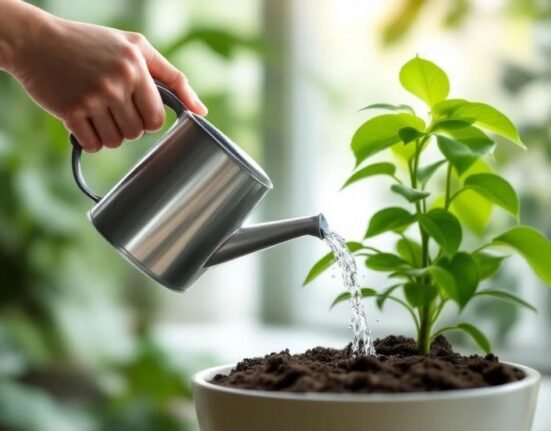
Proper Watering Technique
- Pour slowly and evenly.
- Water until it drains from the bottom.
- Wait 10–15 minutes.
- Empty the saucer.
This ensures:
- Even moisture distribution
- Salt flush-out
- Root zone hydration
Why Deep Roots Matter
Deep roots:
- Access stable moisture
- Tolerate minor drought
- Anchor plant better
Light watering keeps roots near the surface—where they dry out quickly.
4. Adjust for the Seasons
Indoor plants follow seasonal rhythms—even inside climate-controlled homes.
Growth Cycles Overview
| Season | Plant Activity | Watering Need | Feeding Need |
|---|---|---|---|
| Spring | Active growth begins | Increase | Start feeding |
| Summer | Peak growth | Highest | Regular feed |
| Fall | Slowing down | Reduce | Light feed |
| Winter | Dormancy/rest | Minimal | Usually stop |
Winter Watering Rule
In winter:
- Check soil carefully.
- Water less frequently.
- Avoid cold water shocks.
Overwatering in winter is the #1 seasonal killer of houseplants.
5. Feed During Growth — Not Dormancy
Fertilizer is not plant food. It’s a nutrient supplement.
Plants create food via photosynthesis. Fertilizer provides essential minerals like nitrogen, phosphorus, and potassium.
The Basic Nutrient Breakdown
| Nutrient | Role in Plant Health |
|---|---|
| Nitrogen (N) | Leaf growth & green color |
| Phosphorus (P) | Root & flower development |
| Potassium (K) | Overall strength & disease resistance |
You’ll see fertilizer labeled like: 10-10-10 or 20-20-20
Those numbers represent N-P-K ratios.
Feeding Frequency Guide
| Plant Type | Feeding Schedule (Growing Season) |
|---|---|
| Foliage plants | Every 4 weeks |
| Flowering plants | Every 2–3 weeks |
| Succulents | Every 6–8 weeks |
| Orchids | Weakly weekly (diluted feed) |
Dilution Matters
Many indoor plant problems come from overfertilizing.
Golden Rule:
Use fertilizer at half the recommended strength unless plant shows heavy growth demand.
6. Flush the Soil Periodically
Even when feeding correctly, mineral salts accumulate in potting soil.
Signs of salt buildup:
- White crust on soil surface
- Leaf tip burn
- Slowed growth despite feeding
How to Flush Soil
- Take plant to sink or shower.
- Run distilled or filtered water through soil for 1–2 minutes.
- Let drain thoroughly.
Do this every 2–3 months during growing season.
Salt Buildup Risk Chart
| Water Type | Mineral Buildup Risk |
|---|---|
| Rainwater | Very low |
| Distilled | None |
| Filtered | Low |
| Tap (hard) | Moderate to high |
7. Match Feeding to Plant Type
Not all plants crave the same nutrients.
A leafy monstera and a blooming peace lily have different needs.
Feeding Focus by Category
| Plant Category | Ideal N-P-K Ratio | Feeding Emphasis |
|---|---|---|
| Leafy foliage | Higher nitrogen | Lush leaf growth |
| Flowering plants | Higher phosphorus | Bloom production |
| Succulents | Balanced, low | Slow steady support |
| Herbs | Moderate nitrogen | Flavorful leaf growth |
Visual Growth Response Chart
High Nitrogen → Big Leaves, Deep Green
High Phosphorus → Strong Roots, More Flowers
High Potassium → Thick Stems, Disease Resistance
Common Watering & Feeding Mistakes
- Watering out of guilt.
- Fertilizing dry soil.
- Ignoring drainage.
- Using garden soil indoors.
- Feeding in winter dormancy.
- Mistaking yellow leaves for underwatering (often overwatering).
Quick Reference Cheat Sheet
| Rule # | Core Principle |
|---|---|
| 1 | Water soil dryness, not calendar |
| 2 | Always use drainage |
| 3 | Water deeply until runoff |
| 4 | Adjust by season |
| 5 | Feed during growth only |
| 6 | Flush salts periodically |
| 7 | Match fertilizer to plant type |
Troubleshooting Guide
| Symptom | Likely Cause | Solution |
|---|---|---|
| Yellow leaves | Overwatering | Let soil dry more |
| Brown crispy tips | Salt buildup | Flush soil |
| Stunted growth | Underfeeding | Resume feeding |
| Drooping but wet soil | Root rot | Repot & trim roots |
| Pale leaves | Nitrogen deficiency | Balanced fertilizer |
The Rhythm of Thriving Plants
Healthy indoor plants are not high-maintenance. They’re consistent.
They need:
- Oxygen at the roots
- Moisture in balance
- Nutrients in moderation
- Seasonal awareness
Once you tune into that rhythm, care becomes intuitive.
Instead of reacting to problems, you begin preventing them.
And that’s when indoor plants truly thrive.
Frequently Asked Questions (FAQs)
1. How do I know if I’m overwatering my indoor plants?
Common signs include yellowing leaves, soft stems, moldy soil surface, and a musty smell. Always check soil moisture before watering again.
2. Can I use tap water for indoor plants?
Yes, but if your tap water is hard (high mineral content), it may cause salt buildup. Consider filtered or rainwater if you notice white crust on soil.
3. Should I fertilize newly repotted plants?
Not immediately. Fresh potting mix contains nutrients. Wait 4–6 weeks before feeding.
4. Why are my plant’s leaf tips turning brown?
Most often it’s salt buildup from fertilizer or hard water. Flush soil thoroughly and reduce feeding strength.
5. How often should I water succulents indoors?
Typically every 2–4 weeks, but only when soil is completely dry throughout the pot.
6. Is liquid fertilizer better than slow-release pellets?
Both work well. Liquid fertilizer allows precise control and faster absorption. Slow-release is convenient and low-maintenance.
Indoor plant care isn’t about perfection. It’s about observation.
Watch the soil. Watch the leaves. Watch the season.
Follow these seven watering and feeding rules, and your indoor garden won’t just survive—it will flourish.
v